My baskets
You still don't have anything in your shopping cart

My baskets
You still don't have anything in your shopping cart
You still don't have anything in your shopping cart
You still don't have anything in your shopping cart


{{getOldPrice()}}{{getPrice()}}
 ¡ Buying this product you get {{calculatedProductMenttos()}} menttos !
The Papaya, or Carica papaya, belongs to the Caricaceae family. Its origin dates back to Central America and is cultivated in Florida, Hawaii, South Africa, India, Ceylon, the Malay Archipelago, the Canary Islands, and Australia.
Characteristics: The papaya is a fruit that grows in clusters; it has an oval and elongated shape,
and is large in size (it can reach up to 25 cm long and 15 cm in diameter). Its skin can be
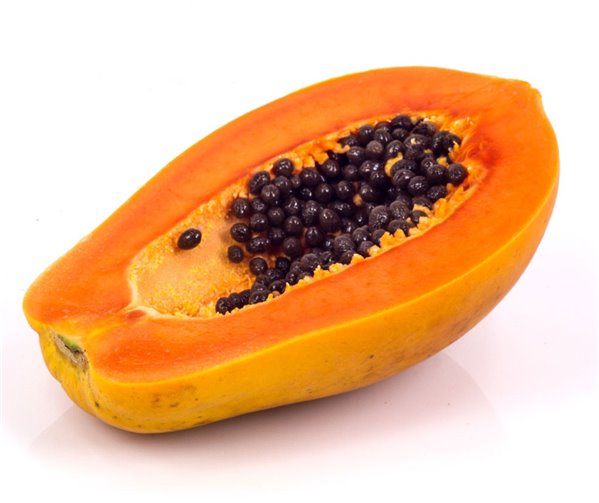
yellow, yellow-green, or orange; its flesh is tender, aromatic, fleshy, and juicy with a reddish-orange color and black seeds.
There are different varieties, including; Solo, Bluestem, Betty, Fairchild, Rissimee, Garahan, Hurtusgred, and Puna. The most popular varieties are those cultivated in Hawaii, Solo and Puna, which generally yield specimens of up to 450 grams and are very sweet.
Consumption: It is mainly consumed as fresh tropical fruit due to its sweet and juicy flesh; it is prepared cut into sugary pieces drizzled with lime juice to enhance its flavor, and it also pairs very well with other fruits in fruit salads or mixtures. Especially delicious when served chilled.
When it is still unripe, it is often consumed as a cooked vegetable, in meat stews, and in marinades as a tenderizer. It has been industrialized into soft drinks, jellies, jams, ice creams, candies, or preserves.
Its flavor is unique, its sweet flesh resembles strawberries and bananas, and the seeds inside add a spicy touch to its fleshy meat. Its texture is creamy, soft, and juicy.
The black seeds can be ground and used for dressing salads or meats; they have a flavor similar to mustard seeds.
Selection: The specimens that yield easily to pressure are the most flavorful; the skin should not have blemishes, and its color should be between yellow and red (the part that has not been exposed to sunlight will be green).
Properties of Papaya:
Its main component is water, followed by carbohydrates; the mineral found in abundance is potassium, and it also contains vitamins C and provitamin A. Its fiber content aids in intestinal evacuation.
It is noteworthy that it contains low proportions of a proteolytic enzyme (papain) used to tenderize meat or clarify beer. This enzyme present in papaya stimulates digestion and is very beneficial for people with stomach issues such as acidity, gastritis, and aids in slow digestion processes due to meat consumption.
Papaya juice is very corrosive; be careful with sensitive and irritable skin, such as that of children.
The Papaya, or Carica papaya, belongs to the Caricaceae family. Its origin dates back to Central America and is cultivated in Florida, Hawaii, South Africa, India, Ceylon, the Malay Archipelago, the Canary Islands, and Australia.
Characteristics: The papaya is a fruit that grows in clusters; it has an oval and elongated shape,
and is large in size (it can reach up to 25 cm long and 15 cm in diameter). Its skin can be
yellow, yellow-green, or orange; its flesh is tender, aromatic, fleshy, and juicy with a reddish-orange color and black seeds.
There are different varieties, including; Solo, Bluestem, Betty, Fairchild, Rissimee, Garahan, Hurtusgred, and Puna. The most popular varieties are those cultivated in Hawaii, Solo and Puna, which generally yield specimens of up to 450 grams and are very sweet.
Consumption: It is mainly consumed as fresh tropical fruit due to its sweet and juicy flesh; it is prepared cut into sugary pieces drizzled with lime juice to enhance its flavor, and it also pairs very well with other fruits in fruit salads or mixtures. Especially delicious when served chilled.
When it is still unripe, it is often consumed as a cooked vegetable, in meat stews, and in marinades as a tenderizer. It has been industrialized into soft drinks, jellies, jams, ice creams, candies, or preserves.
Its flavor is unique, its sweet flesh resembles strawberries and bananas, and the seeds inside add a spicy touch to its fleshy meat. Its texture is creamy, soft, and juicy.
The black seeds can be ground and used for dressing salads or meats; they have a flavor similar to mustard seeds.
Selection: The specimens that yield easily to pressure are the most flavorful; the skin should not have blemishes, and its color should be between yellow and red (the part that has not been exposed to sunlight will be green).
Properties of Papaya:
Its main component is water, followed by carbohydrates; the mineral found in abundance is potassium, and it also contains vitamins C and provitamin A. Its fiber content aids in intestinal evacuation.
It is noteworthy that it contains low proportions of a proteolytic enzyme (papain) used to tenderize meat or clarify beer. This enzyme present in papaya stimulates digestion and is very beneficial for people with stomach issues such as acidity, gastritis, and aids in slow digestion processes due to meat consumption.
Papaya juice is very corrosive; be careful with sensitive and irritable skin, such as that of children.