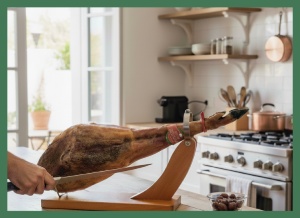
Ham from a purebred Iberian pig, fed with feed, grass, and other resources from the dehesa, raised in freedom, guaranteed by Hidalgo de los Pedroches.
Shipping costs included.
Shipping within 24-48 hours.
IDENTIFICATION OF THE PIECES ACCORDING TO THE TAGThe Ham can be quickly identified by the label found on the hoof. There are four colors:
- Black Tag: for 100% Iberian acorn-fed Ham: The black label on the ham indicates that it is from a 100% Iberian breed and that during the fattening months, it has been fed with acorns and grass in a free-range pasture. Its parents will be 100% Iberian and must be registered in the Genealogical Book of the Iberian pig breed.
- Red Tag: for Iberian acorn-fed Ham: These are hams that come from pigs with between 50% and 75% Iberian breed that have been fed with acorns and grass in a free-range pasture during the fattening months.
- Green Tag: for Iberian Field Cebo Ham: These hams come from specimens with between 50% and 100% Iberian breed; however, they have not been fed acorns in the pasture, only with feed and natural resources in free-range.
- White Tag: for Iberian Cebo Ham: These also come from Iberian specimens, with a percentage between 50% and 100%; however, they have not been raised in the field. They have been fed with feed on farms.
PROTECTED DESIGNATION OF ORIGIN (PDO)This constitutes the system used in our country for recognizing a differentiated quality, resulting from unique and distinctive characteristics due to the geographical environment in which the raw materials are produced, the products are made, and the influence of the human factor involved in them.
The producer who adheres to a PDO commits to following the defined standards to maintain quality at high levels.
Additionally, there must be a public body that regulates it and monitors compliance with the rules. In the case of Spanish PDOs, they are protected by European regulation.
What are PDOs for?For the consumer, fundamentally to guarantee specific characteristics and a high and constant level of quality.
And for the manufacturer, it protects against the production of similar products in other areas and helps to reach new markets, backed by the quality of the PDO.
How is the breeding of Iberian pigs?Our 100% Iberian breed pigs are born in the field, suckled by their mothers until they are old enough to fend for themselves and begin to feed on the resources of the pasture. Those piglets born in autumn can enjoy their first acorns during this weaning phase; however, most of these will be reserved for their older siblings, who were born a year earlier and reach the montanera phase (fattening phase) weighing between 90-100 kg to 170-180 kg solely on acorns, grass, and other natural resources from the pasture (mushrooms, roots, tubers, etc.).
What do the pigs eat before the fattening phase?They feed on the resources of the pasture; however, during the summer season when resources are scarce, they are usually fed with natural feeds primarily composed of grains and legumes. The farmers of the society plant these grains and legumes (chickpeas, broad beans, vetch, oats, etc.) so that by summer, the pigs can feed on them
ad libitum, meaning at will in the same area, without the need to harvest them.
Temperature, humidity, and aging time of hams and shoulders.The process of making our hams and shoulders has several phases. The first phase, salting, is done at very low temperatures and high humidity. This phase lasts about 2 weeks depending on the weight of the piece, and subsequently, after settling in chambers with controlled temperature and humidity, they will move to natural cellars, where the temperature will range from 18-20 degrees in the summer to 10-12 degrees in the winter, a slow curing that ensures a long and optimal aging of over 30 months, achieving aromas that an accelerated process could never obtain.
Translated automatically


 ¡ Buying this product you get {{calculatedProductMenttos()}} menttos !